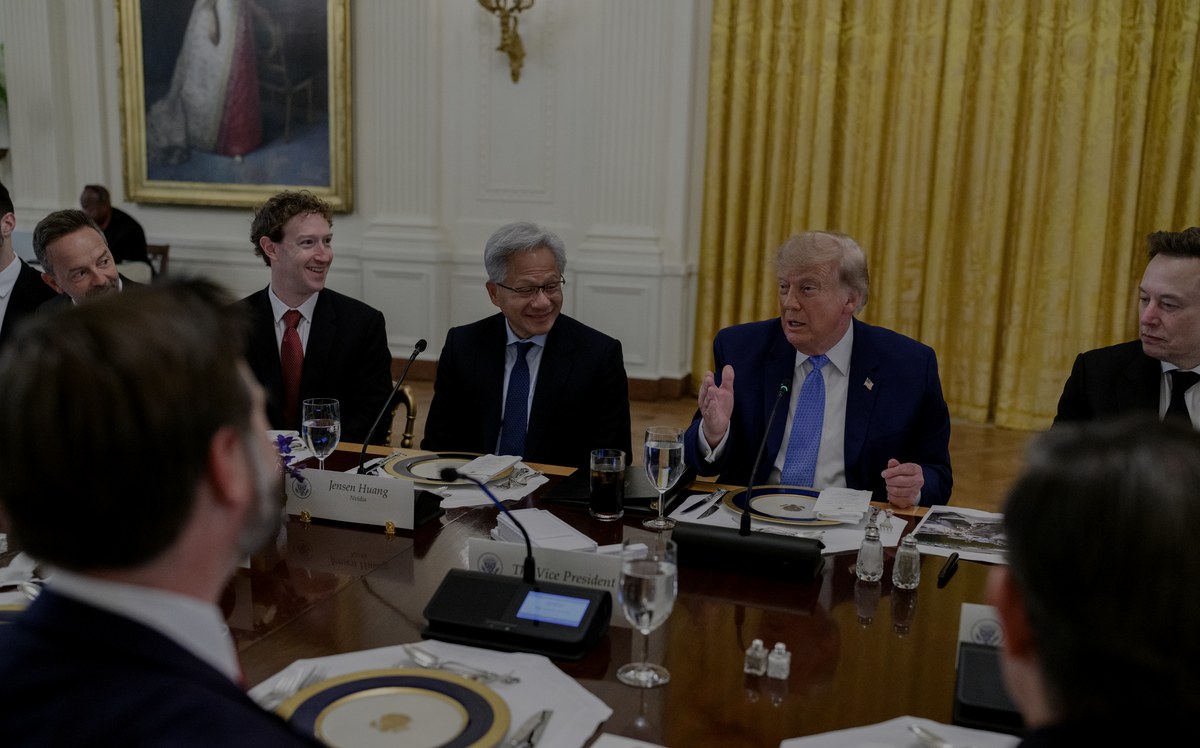
On September 29, 2026, the White House signed Executive Order 14434 and told every federal agency to stop saying "Artificial Intelligence" and start saying "Super Intelligence." Six CEOs, Pichai, Zuckerberg, Amodei, Brockman, Musk, and Huang, signed an accord in the East Room the same afternoon. A week later a YouGov poll found 53% of people still preferred the old term. Only 9% liked the new one.
I build on top of this stuff for a living, AI content systems, automation pipelines, affiliate sites that live or die on search visibility. So the name change itself doesn't move my work one inch. What's underneath it does. This is the starter guide I wished existed when I went looking: what actually changed, what didn't, and what I'm doing differently because of it.
What EO 14434 actually does
Strip the headlines and the order is narrow. It tells executive branch agencies to use "Super Intelligence" and "SI" in official communications, websites, policy papers, and procurement documents, non-statutory material only. It also tasks the White House Office of Science and Technology Policy with drafting a formal legislative definition of SI within 60 days.
That's it. No new regulation. No change to 15 U.S.C. § 9401(3), the existing statutory
definition of AI. No change to how a transformer model actually computes a token. Computer science
professor Pedro Domingos called it what it is: companies have every incentive to call their product
"super, hyper, superior," and this is marketing wearing an executive order.
California didn't play along. Governor Newsom signed his own order the same week declaring that, in California, Artificial Intelligence stays Artificial Intelligence. That split alone tells you this is a branding fight, not a technical one.
Academic computer science still defines Artificial Superintelligence (ASI) as a hypothetical future system that beats humans at virtually every cognitive task. Today's frontier models, whatever the label on the press release, aren't that. They're fast, multilingual, strong at code and math. They still hallucinate, still drift on long tasks, still need a human checking the output. The rebrand didn't close that gap. It just renamed the side we're standing on.
The terms you'll see replacing the old ones
Expect vendor docs, job titles, and SLAs to drift toward this vocabulary over the next few quarters. Some of it is useful shorthand. Some of it is the same thing with a more expensive-sounding name.
| Old term | New term you'll see | What actually changed |
|---|---|---|
| Artificial Intelligence | Super Intelligence (SI) | Label only, under the hood is still neural nets at scale |
| Prompt Engineering | SI Agentic Choreography | Real shift: single prompts → orchestrated multi-agent workflows |
| Large Language Model | Frontier Reasoning Engine | Real shift: word prediction → multi-step reasoning, symbolic math |
| Robotics / Automation | Physical SI / Embodied SI | Real shift: scripted robots → self-learning physical systems |
| Cloud Data Centers | SI Infrastructure | Real shift: standard racks → gigawatt-scale clusters, custom silicon |
Notice the pattern. Row one is pure rebrand. Rows two through five describe things that were already happening before the executive order existed, agent orchestration, reasoning models, embodied AI, and gigawatt data centers were all trending hard through 2025. The name change just gave reporters a hook to write about trends that were already underway.
Who signed the accord, and what it actually commits them to
The "White House Accord on Super Intelligence: Joint Commitment on Frontier Responsibilities" was signed by Pichai (Google), Amodei (Anthropic), Zuckerberg (Meta), Brockman (OpenAI), Musk (xAI), and Huang (Nvidia). It calls for internal monitoring, independent auditors, and shared safety standards across frontier labs. Voluntary, not binding, enforced by the companies on themselves.
Axios and CNBC both flagged the same tension right after the signing: the administration is betting on industry self-oversight to keep development fast, while critics inside the room were already arguing binding guardrails are needed as models get more capable. OpenAI reportedly delayed a flagship release over internal alignment concerns around the same time, so "we'll regulate ourselves" is already being tested in public.
What this means for how I actually work
I'm not rewriting my service pages to say "SI Solutions Architect" because a press release told me to. But three things in the underlying doc I researched for this piece are real, and I'm acting on them.
- Orchestration beats prompting now. The useful shift isn't the name, it's that single-prompt workflows are getting replaced by agents that chain tools, APIs, and memory together. I'm running more of my content and SEO pipeline through n8n and Claude's agent tooling instead of one-off prompts in a chat window, the same shift I mapped out in building alone: tools, habits, and what I outsource to AI.
- The harness matters as much as the model. Benchmarks like SWE-bench Verified and Terminal-Bench 4.0 measure model-plus-harness performance together. Picking a frontier model and bolting on a weak agent framework gets you worse results than a mid-tier model in a well-built harness.
- Auditing output is now a core skill, not a nice-to-have. The faster agents execute, the more a single bad assumption compounds across a workflow. I check every automated output against a plain question: would I publish this if a client sent it to me cold?
Sorting my own workflow into three buckets
The clearest practical idea in the source material I dug through wasn't the terminology glossary, it was a simple audit: sort every task you do into full automation, a centaur workflow, or human-only. I ran my own week through it.
- Full automation: keyword clustering, first-draft outlines, IndexNow submissions, OG image generation, sitemap updates. An agent does these end to end now, I spot-check weekly instead of doing them by hand, same pipeline I cover in how I track and optimize for Google AI traffic.
- Centaur workflow: this exact post. Research pulled by an agent, structure drafted with one, but the voice, the skepticism, the decision to call out the YouGov number, that's me. Centaur means the human still drives.
- Human-only: client calls, pricing conversations, anything where someone needs to feel heard, not processed. No agent framework touches this bucket, and I don't expect that to change soon.
Simon Coghlan, a digital ethics lecturer at Melbourne, said it plainly: calling current models "super intelligence" exaggerates what they can actually do today. I agree with him and I'm still building agent pipelines as fast as I can, because the capability curve underneath the label is real even when the label is theater. Both things are true at once.
A four-week starter path if you're catching up
If you're coming into this cold, skip the terminology debate entirely and spend four weeks on the stuff that actually compounds.
| Phase | Focus | What "done" looks like |
|---|---|---|
| Weeks 1–2 | Tool mastery | Daily use of an agent-capable assistant (Claude, Cursor, Replit Agent) on real work, not toy prompts, see my running list in AI tools: reviews, use cases & alternatives |
| Weeks 3–4 | Workflow automation | One real pipeline built in n8n or a similar tool, connecting at least two tools or APIs end to end |
| Week 5+ | Domain synthesis | A finished project in your actual field, not a demo, that an agent helped ship, the approach I lay out in productize yourself with AI |
That path works whether the industry ends up calling it AI, SI, or whatever gets crowdsourced next. The skill underneath, specify clearly, orchestrate agents, audit the output, is the same skill no matter what's printed on the executive order. If you run a site or a brand, the SEO side of this deserves its own breakdown, I cover it in how to dominate SEO in the age of Super Intelligence. If you're based here, I also checked whether the rebrand actually landed locally in Super Intelligence in the Philippines.
Key takeaways
- EO 14434 renames AI to SI inside federal agencies only. No statute, no architecture, no capability changed.
- 53% of the public still prefers "Artificial Intelligence" over "Super Intelligence" per YouGov, this rebrand hasn't landed with regular people.
- The real shifts hiding under the new vocabulary, agent orchestration, reasoning models, embodied robotics, gigawatt infrastructure, were already underway before the name change.
- Sort your own work into full automation, centaur, and human-only buckets. That audit matters more than any label.
- The six-company safety accord is voluntary. Treat "we'll self-regulate" as a claim to watch, not a guarantee.
What I'll do next
I'm running the three-bucket audit across tipidnation.com and europricedrop.com next, both have more repetitive, high-volume tasks than this site, so I expect a bigger chunk to land in the full-automation bucket. I'm also watching whether "SI" actually shows up in search queries over the next two months. If people start typing it, I'll build content around it. If the YouGov number holds, I won't bother.
FAQ
Is "Super Intelligence" a real technical term or just marketing? +
Do I need to change how I describe my AI work because of EO 14434?
What's the difference between prompt engineering and "SI agentic choreography"?
Which skills actually matter in the "SI era"?
Is the White House safety accord legally binding?
Want this built for your team?
I design AI agents and growth automation that run without babysitting. If that sounds useful, let's talk.
Get in touch →